Investigate some artists’ self portrait, both well known artists and lesser known artists.
Edward Hopper (American painter, 1882-1967)
 When thinking whom to select, Edward Hopper came to my mind whose self portraits I had seen in the recent Hopper Exhibition, showing him as a young man and again later in his fifties. The later portrait showed much more of his personality and presented him as a real character, whereas the young man looks in a way like a blank sheet.
I found it interesting to compare the self portraits with photographs of Edward Hopper. The earlier one dates back to his highschool graduation in 1899 at age 17. The later one shows him in mature age, maybe 50?


It’s also interesting to compare the three self portrait at older age which were executed in different media. The black and white drawings are later, both from 1945. I saw both of them at the Hopper Exhibition but unfortunately did not take pictures, so I’m including images from the web instead. It can be seen that one of them, which is indicated as made with conté pastels, is much softer, compared to the other one. I think that other one was made using a soft pencil or some other medium that permitted crisper contours. The difference was visible in the online exhibition as well, it’s not only a problem of web image quality.


It really fascinates me how masterly Hopper made the tonality of this drawing.
 The much earlier oil painting (c. 1925-1930) also has this mastership of tonality, only here this is translated into colours in a very generous way without unnecessary detail.
Vincent van Gogh (Dutch painter, 1853-1890)
 I’m a great admirer of Vincent van Gogh and therefore included him in this research. The first self portrait I chose surprised me because I thought it was a portrait of Vincent as a young man, but then learnt it was the last self portrait before his death. I perceived the expression in his eyes as very broken and lost. It was the only self portrait without a beard. Van Gogh himself seems to have been conscious about this and titled it “self portrait without beard” (1889).
 Only three years earlier dates a portrait of van Gogh by John Peter Russel. I find it striking how different van Gogh’s personality comes across. In that portrait, van Gogh is depicted as a respectable, confident, yet a bit suspicious man, with a small brush indicating his profession.
Van Gogh died when Edward Hopper was a child, and photography was only in its beginnings. The wikipedia article on van Gogh’s self portraits included only one photograph which might or might not show van Gogh, experts are said to disagree. So I took this portrait as the corresponding “other” view on the artist, instead of a photograph. Where Edward Hopper resembled closely the photographs of him, I perceive much difference between Russel’s portrait and van Gogh’s self portrait. It may have to do with the effect of using a mirror for self portraits, compared to the direct look of someone else, which switches the left and right side of the face. But then, Hopper’s self portraits should exhibit a similar bias, but I don’t see that.
 Then I selected the very earliest self portrait I found, made in Paris, Fall 1886, at age 33. A date comparison made me realize that van Gogh died as a young man, at age 37. There were only 3 years between this and his last self portrait without beard. In these three years, van Gogh has produced 36 self portraits, most of which were in oil on canvas. This is roughly one self portrait per month – and this does not include all the other paintings and drawings made in these years, including those that have gone lost in time. He must have painted like furious!
 Van Gogh depicted himself mostly with the nose pointing to the left, in particular in the later self portraits after he had mutilated his ear. But there are also some that show his ear bandaged, for example the “self portrait with bandaged ear” (1889).
 I found the self portrait with felt hat (winter 1887-88) stood out from the others through the choice of colour and technique. Most other self-portraits are more naturalistic in colour and combin and blend colder and warmer tones, whereas this one has a dominant contrast of black, an ultramarine blue and wine red. Skin and hat appear pale. The technique resembles woodcut, with the blue brushstrokes for the suit like carved out from the black background, and wine red smaller strokes in circles around the head for the background. The accompanying text explains that this painting reflects the influence of Pointillism on van Gogh, who lived in Paris at the time.
 As a last self portrait by van Gogh, I chose the one I found most naturalistic. Maybe this one is closest to the view other people had of him and how he was portrayed by Russel. For me it is one of the few that are not “somehow strange” by the choice of colour or technique.
Searching for less well known artists, my first idea was Georg Kolbe whose figurative drawings I had admired. But I couldn’t find any self portraits by him. Meandering a bit through the image world, I stumbled across a self portrait by Käthe Kollwitz, a German painter and printmaker.
Käthe Kollwitz (Germany, 1867 – 1945)
She was approximately a contemporary of Edward Hopper, born around 20 years earlier in Germany. Van Gogh’s death was in her early twenties.
The first self portrait I chose shows her with head leaning on the hand, 1889-91, Pen and ink on paper. I love this one for the attitude it conveys, which reminds me of my own self-portrait in coloured pencil. It conveys something of teenage rebellion. Käthe Kollwitz was in her early twenties when she made this self portrait. She used a mix of pen and ink and washes for tonality. This was combined with hatching to create tones. The technique supports the unconventional and experimental overall impression of this self portrait. I found a photograph at presumably more mature age with a similar posture and somehow there’s much correspondence to the personality that comes across in the early self portrait.


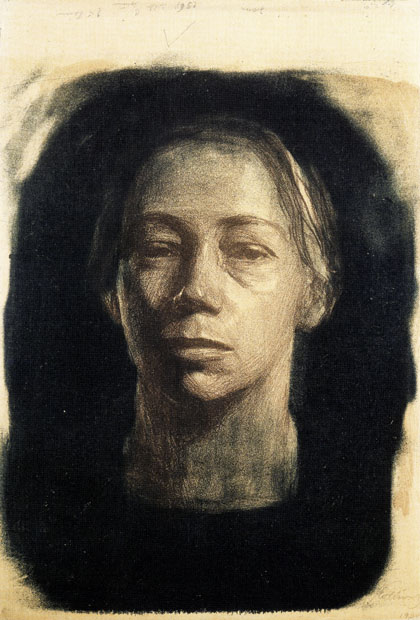
 I found another self portrait at relatively young age. Unfortunately there was no corresponding documentary information, but I found a reference elsewhere which indicates the date as 1903-04. It looks like a technique combining watercolour washes with charcoal. There are very deep contrasts from very dark to very light but the blendings are subtle.
The next self portraits I chose are from older age. I’m impressed by the courage she had in depicting her wrinkles and other signs of age in her face. I remember that in my own self portraits I was less courageous and had a tendency to leave out “ugly” aspects. Maybe that lack of courage to depict what I saw resulted in drawings that did not really resemble me…


 As the last self-portrait from Kätze Kollwitz I chose a bronze sculpture which is dated 1926-1932, where she was in her sixties. It’s a nice reminder that artists’ self portraits are not restricted to two-dimensional works.
Overarching aspects
Influence of the times – how each artist can be located within influences of contemporaries and predecessors, and how history influences the production of art.
Comparison between young and old – Not only changes the perception of self throughout life, so does its depiction in self-portraits.
The subjective vs the objective view – The self-portrait as a subjective view, can be similar or very different from the outsider’s view through a camera or portrait.
References
Edward Hopper
Whitney Museum, Edward Hopper Self portrait, Oil on canvas http://whitney.org/Collection/EdwardHopper/701165
Edward Hopper Photograph http://americanart.si.edu/search/artist_bio.cfm?ID=2297
Edward Hopper 1945 Self portrait, conté on paper http://phillippblog.blog.de/2009/10/05/edward-hopper-46-epilog-7101636/
Edward Hopper 1945 Self portrait, medium unknown http://www.nysun.com/pics/9049.jpg

Vincent van Gogh
Wikipedia article on the artist’s self portraits http://www.nysun.com/pics/9049.jpg
Käthe Kollwitz
Käthe Kollwitz Museum Köln (available in English) http://www.kollwitz.de/en/default.aspx
Self portrait 1889-91 pen and ink http://www.kollwitz.de/swf/zeitstrahl/bilder_zeitstrahl/48_N_T25.jpg

Käthe Kollwith photograph http://3.bp.blogspot.com/-NOQ_KK6j_Ic/Tj9TWsDXLiI/AAAAAAAAApQ/8QD7pi2t-0Y/s1600/kollwitz.jpg

Watercolour self portrait http://museen.de/bild.php?id=9918555&w=feat , corresponding image dated 1903-04 from http://le000310.host.inode.at/bilder/Kollwitz_Kaethe_Selbstbildnis_1903_04.jpg
Bronze sculpture http://www.kollwitz.de/module/werkliste/Details.aspx?wid=403&lid=8&head=Tour+-+Self-portraits&ln=e